

Machine Learning for Human Learning: What Actually Works Today
At Magic Solution, we're always fascinated by the intersection of technology and human potential. W. Szabó Péter's latest piece, Machine Learning for Human Learning: What Actually Works Today, hits the nail on the head: AI isn't about replacing teachers or students—it's about empowering them. From adaptive practice to instant feedback, machine learning is quietly transforming how we learn, especially in high-stakes fields like healthcare and pharmacy. In this article, Péter breaks down practical, real-world applications that actually improve learning outcomes today—no hype, just tools that make learning smarter, faster, and more reliable.
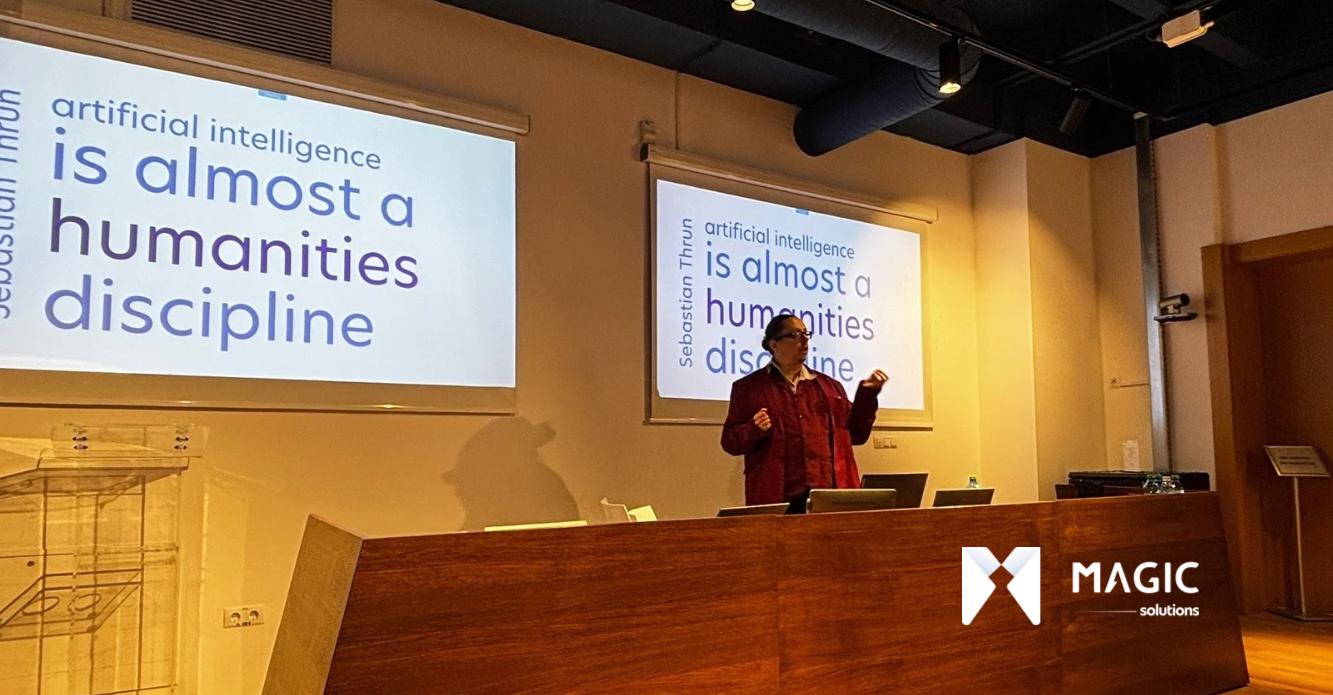
This post is based on my talk at Tanulás 180° on October 18, an event by the Saint Blaise Foundation. But let's keep the spotlight where it belongs: on what's working right now.
We don't learn the way we think we learn. Not anymore.
Cramming the night before. Endless PDFs. Guess-and-check study habits. It's a bit like trying to run a marathon in dress shoes—possible, but painful and slower than it has to be.
Machine learning (ML) is changing that. Quietly. Practically. Not with sci-fi robots, but with everyday tools that nudge us toward better habits, clearer feedback, and safer practice. And when you're training clinicians and pharmacists—the stakes are high enough that "better learning" is not a nice-to-have. It's patient safety.
Let's cut through the buzzwords and look at what's already helping.
What we get wrong about AI in education
We often imagine AI as a black box that replaces teachers or automates students' thinking. That's not the useful frame.
A better one: AI as a tireless teaching assistant—always on, ruthlessly consistent, and unusually good at pattern-spotting. People still lead; AI scales support.
In practice, that means a few simple, powerful shifts:
- From one-size-fits-all to adaptive practice. Right task, right time, right difficulty.
- From slow feedback to instant coaching. Micro-corrections while the skill is forming—not weeks later.
- From guesswork to signals. Early alerts when a learner is drifting or stuck.
How ML helps people learn (in plain language)
Think of ML as "learning from examples." Feed it thousands of cases—X-rays, quiz attempts, progress logs—and it learns patterns that predict performance, surface misconceptions, and recommend the next best step. It's like having a data-savvy co-coach whispering, "Double down here. Skip that. Try this next."
The key isn't magic. It's feedback loops:
- Observe (your attempts, your timing, your misses),
- Analyze (what trips you up),
- Adapt (serve a targeted task), and
- Repeat—fast.
Healthcare & pharmacy: concrete use cases that work
1) Imaging as a learning partner (not just a diagnostic tool)
Modern image-analysis models don't "grade" students; they highlight what a clinician would scrutinize—suspicious regions, unusual textures, subtle asymmetries. For students, this becomes a powerful deliberate practice routine:
- Review the image alone → commit to your read,
- Reveal AI highlights → compare and explain the differences,
- Log why the model flagged something → reflect,
- Re-test on variants → close the loop.
You're not outsourcing thinking; you're sharpening attention.
2) Virtual patients you can "break" safely
Generative AI enables conversational patient simulations. Students take histories, test hypotheses, explain plans—then receive structured feedback on clinical reasoning and communication (missed red flags, empathy moments, clarity). You can repeat tricky scenarios endlessly, spiral difficulty up, and capture growth over time.
3) Surgical skills: VR + ML coaching
VR gives the sandbox; ML gives the coaching telemetry. The system measures path smoothness, force, sequence adherence, sterile-field discipline—then returns specific, objective cues: "Your retraction is inconsistent in quadrant C," or "You're skipping verification steps under time pressure." It's the difference between "do better" and how to do better.
4) Pharmacy learning accelerators
- Mechanism maps generated on demand: quickly visualize how a drug moves through pathways, then quiz yourself on mechanisms of action vs. side effects.
- Error-aware study plans: ML spots topics that consistently trigger slips (e.g., look-alike/sound-alike meds) and increases spaced exposure before checkout.
- Case-based counseling practice: role-play conversations for adherence, adverse events, or OTC triage—with instant, rubric-aligned feedback.
The quiet powerhouse: learning analytics that care
Great educators already notice patterns: who's avoiding practice sets, who sprints the night before an exam. ML just surfaces those patterns earlier and more consistently.
A humane approach:
- Early nudges to students: "Your practice cadence dipped this week; here's a 15-minute set to rebuild momentum."
- Signals to faculty: "These five learners show growing misconception on anticoagulants."
- Friction-free support: short office hours, targeted micro-lectures, or peer-study matches—before the panic.
It's not surveillance; it's scaffolding. The goal is to intervene kindly and early, not to punish.
AI tutors done right: prompts that teach thinking
Good AI tutors don't dump answers; they ask better questions. You can steer them with a simple prompt pattern:
- Goal: "Help me master non-inferiority trial design."
- Context: "I'm a pharmacy student; I know basics but struggle with margins and interpretation."
- Role & format: "Act as a Socratic tutor. Use short questions. One at a time."
- Constraints: "No final answers until I attempt. Provide a worked example at the end."
- Reflection: "After we finish, quiz me and summarize my weak spots."
That's not "cheating." That's structured metacognition.
A 10-minute, real-world micro-practice
Pick a topic you genuinely find tough—say, differentiating upper vs. lower motor neuron lesions.
- Self-explain the distinction in 4–5 sentences.
- Ask an AI tutor to probe your explanation with questions only.
- Edit your explanation based on those probes.
- Request two exam-style items (one easy, one tricky) and attempt them.
- Ask for a one-paragraph "watch-out" summarizing your most likely traps.
You'll feel the gears turn. That's learning.
What educators can deploy this semester (without a giant platform)
- Rubrics + AI: Publish your rubric. Have AI generate practice questions tagged to rubric criteria. Students see how they're being evaluated, not just that they are.
- Case banks with progressive disclosure: Start with a bare complaint; unlock vitals, labs, imaging only when asked well. AI tracks which clues students chronically miss.
- Low-lift early alerts: Even a weekly export from your LMS run through a simple model can flag activity cliffs and concept clusters needing a mini-intervention.
- Feedback macros: Draft short, high-frequency comments ("missing mechanism link," "explain risk–benefit trade-off"), then personalize. You'll return feedback faster and make it more consistent.
Guardrails that build trust
Let's be adults about the risks and still move forward confidently.
- Human in the loop. AI suggests; people decide.
- Source or it didn't happen. Always ask for citations when content is factual.
- Bias checks. Periodically review outputs for systematic drift or blind spots.
- Privacy basics. Don't paste patient data into tools. Use institution-approved systems for sensitive content.
- Assessment integrity. Keep high-stakes evaluation human-led; use AI for practice, not final judgments.
A simple rule-of-five to pilot anything AI-powered
- Design to a single, clear learning outcome.
- Start small (one module, one cohort).
- Measure two things (engagement + performance deltas).
- Document the workflow (so others can repeat it).
- Keep the human judgment for consequential calls.
Done beats perfect. Iteration beats speculation.
The point of all this
AI isn't here to replace curiosity, empathy, or professional judgment. It's here to buy them time. The machine is fast; the clinician is wise; the student is curious. When those three collaborate, learning feels different—lighter, clearer, more durable.