

Turbulent Times, Bold Opportunities — Insights from the RMKT Conference
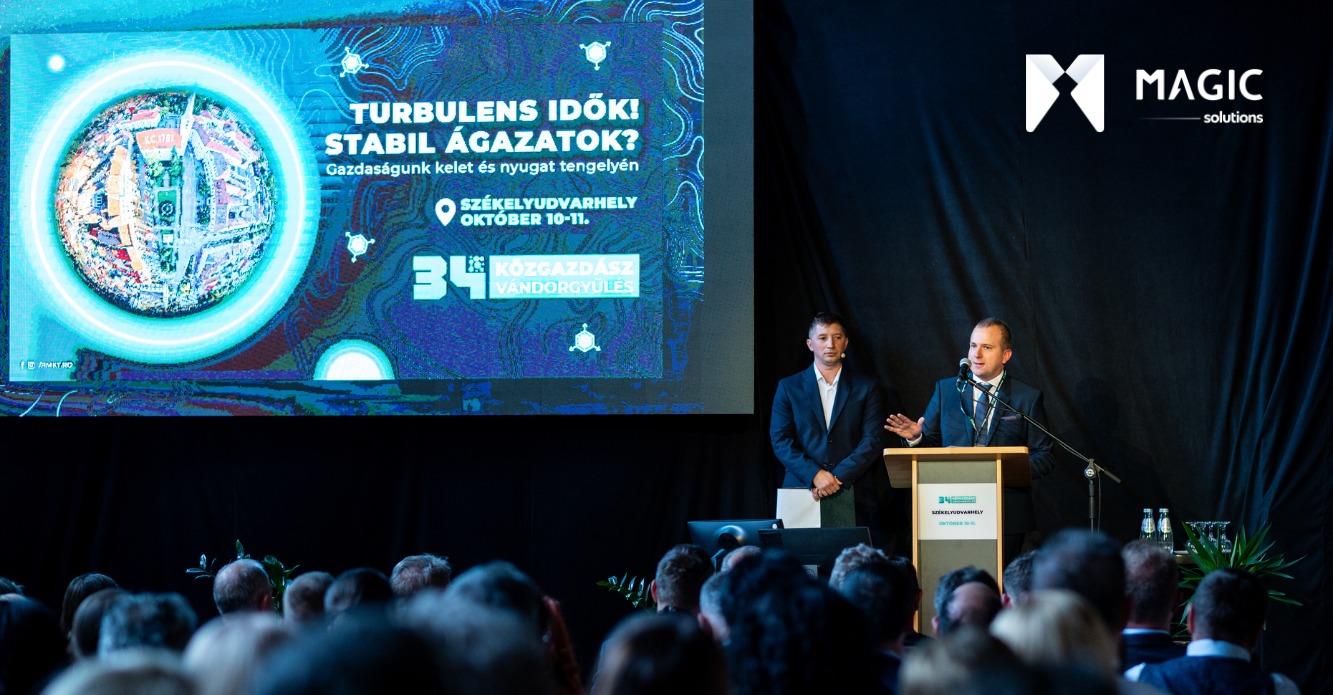
At Magic Solutions, we follow discussions that shape the industry. Our Tech Lead, Csatlós Sándor, attended this year's RMKT Conference, themed "Turbulent Times! Stable Sectors?"
He observed that the months ahead will bring challenges, but also opportunities for those willing to work hard and adapt.
In his reflections below, Sándor highlights key points from the conference — including economic trends, the role of AI, and the skills needed to navigate a changing business environment.
"The theme of this year's RMKT Conference was "Turbulent Times! Stable Sectors?"
The title itself is intriguing: it contains both a statement and a question.
What we can all agree on is that there is no doubt we are living in turbulent times. The world around us is changing rapidly, and this directly connects to the main question: does a stable sector even exist in today's world?
The discussions approached the topic from several perspectives, which helped us gain a broader understanding. We heard from analysts observing the trends from the outside, company leaders who experience these challenges daily, and politicians who shared their own viewpoints to help us understand their approach as well.
The overall tone of the presentations was balanced. From an economic perspective, Aurél Bernát, CEO of BT Asset Management, emphasized that Romania still offers some of the best investment opportunities in the region.
Several presentations also mentioned that Romania's economy had been approaching the EU average in recent years. However, this momentum has now slowed significantly, and Romania is currently struggling with a twin deficit.
Our politicians are working on reducing public debt, but in the short term, they cannot promise strong results, as reducing budget deficits involves difficult decisions and it will take years to stabilize and decrease the debt. This is further compounded by the economic slowdown.
We all know that energy prices have been extremely unstable recently, strongly affecting our daily lives. However, a positive development for our country is that by 2027, the Neptun Deep offshore gas extraction project will be completed. This will make Romania the largest gas producer in Europe, which will certainly help stabilize energy prices — as highlighted by Franck Neel, Board Member of OMV Petrom, responsible for Gas and Power.
When it comes to risk analysis, Alina Popa, Country Manager of Coface Romania, noted that she does not really see truly stable sectors in today's world.
Two of our colleagues, Tünde Jakabos and Péter W. Szabó, also took part in the panel discussions. I personally joined the HR panel, as last year's session was very engaging — and this year did not disappoint either.
The discussion again featured multiple viewpoints:
Tünde represented the perspective of a multinational company, while Nóra Dobre and Nevenca Doca hold senior HR roles in major Romanian corporations.
Andrea Csep, RMDSZ Member of Parliament, and Dr. Botond Dániel, lecturer at Babeș–Bolyai University, also contributed their insights.
Naturally, the conversation touched upon the role of AI and how it is transforming the labor market — as well as what soft skills employees need to succeed in today's changing and ambiguous world.
Several key skills were mentioned, including resilience, learning how to learn, critical thinking, and, of course, digital competence.
For older generations, digital adaptation is often more challenging, but this can be supported through initiatives such as reverse mentoring, where younger employees help senior colleagues acquire digital skills.
One particularly fascinating presentation for me was held by Dr. Dezső Szenkovics, Dean and Associate Professor at Sapientia Hungarian University of Transylvania, who spoke about geopolitics.
According to him, the U.S.-dominated world order appears to be shifting, with new global powers entering the geopolitical competition — including China, India, and Russia.
The big question is: How will the world transform?
Will the United States manage to maintain its dominant position?
Will China and the U.S. share global leadership?
Or will we see the emergence of a multipolar world, where several regional powers coexist?
As Dr. Szenkovics pointed out, Europe must remember one essential fact: Russia will always remain our neighbor, and this reality will not change."
At Magic Solutions, we focus on turning ideas into practical, AI-driven solutions. Even in times of change, we help our partners apply technology to address challenges, improve processes, and seize opportunities.