

Social share blurb
Autonomous AI agents working together to push predictive technology to its limits — not science fiction, but the reality we're heading toward by 2026. At the Digital Székelyföld Conference, W. Szabó Péter shared how this future is already taking shape.
Corporate Innovation 2026: A Swarm of Autonomous AI Agents Running Predictive Technology at Full Throttle
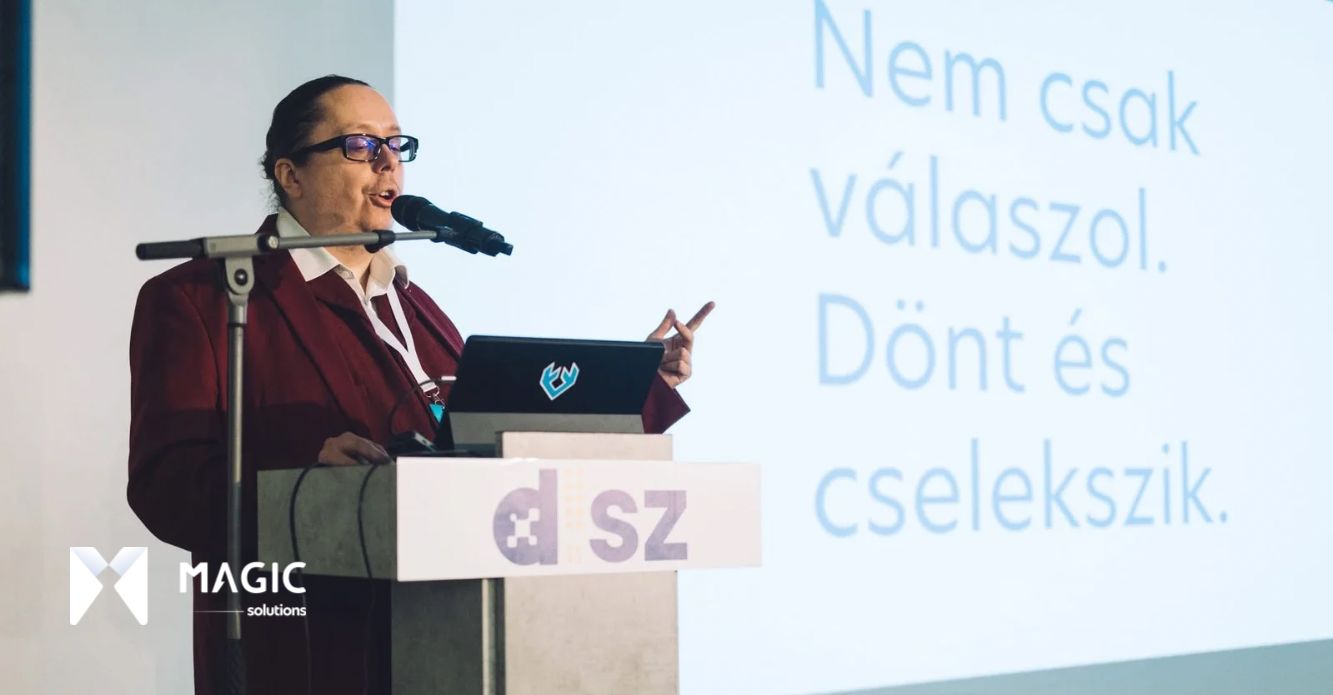
On Friday, October 24, at the Digital Székelyföld Conference in Székelyudvarhely, W. Szabó Péter, Head of AI at Magic Solutions, gave a talk titled "Corporate Innovation 2026: A Swarm of Autonomous AI Agents Running Predictive Technology at Full Throttle."
In just 20 minutes (15:30 – 15:50), he painted a vivid picture of how businesses will soon harness entire swarms of intelligent agents to transform everyday operations. The session explored how deploying multiple collaborative AI agents can take predictive technology beyond analytics — toward self-directed, decision-making systems that drive genuine business innovation.
Why This Matters for Businesses
We're standing on the threshold of a new wave of digital transformation. After automation and cloud computing, the next leap is agentic AI — systems that can learn, decide, and act autonomously within defined boundaries.
For companies, this isn't a futuristic curiosity; it's becoming a competitive necessity. As markets move faster and data volumes explode, real-time decision-making has become mission-critical. Szabó emphasized that multiple specialized agents working together don't just accelerate workflows — they reshape entire business models.
Analysts estimate that by 2026, over one billion AI agents will be active across industries, continuously automating, monitoring, and learning. This shift won't merely boost efficiency; it will redefine how enterprises function. The takeaway? Businesses that act early will gain a decisive edge — responding faster, predicting trends before they surface, and cutting human error to a minimum. Those that wait may find themselves struggling to catch up in a world where predictive, AI-driven operations are the new standard.
Key Insights and Examples from the Talk
Many specialized AIs > one superintelligence.
The future of corporate AI isn't a single omniscient system but a network of focused digital teammates. Each agent excels at its own task, and together they outperform any monolithic "do-it-all" model. "Don't think of AI as one genius — think of it as a well-coordinated digital team," Szabó remarked.
From reactive to proactive operations.
Swarms of agents enable companies to shift from reacting to problems to anticipating and preventing them. Agents continuously monitor data streams, detect anomalies, and take pre-emptive action — fixing issues before they happen. Predictive technology "at full throttle" means every process operates with foresight. As Szabó put it: "The era of reactive support is ending; agent-driven prediction is taking over."
Practical illustration.
Imagine a company's digital workforce: one agent summarizes meetings, another books travel, a third analyzes customer calls, a fourth tracks competitors. Each works independently but feeds into a shared context — collectively handling complex workflows end-to-end without human intervention. The result: faster responses, fewer errors, smoother operations.
The human role.
Szabó stressed that AI agents won't replace people — they'll augment them. Humans will define goals, supervise systems, and ensure ethical use. As he phrased it: "Your AI agent will be your colleague, not your competitor." The challenge lies in building the right infrastructure, data security, and trust frameworks. Pilot projects and employee training are essential to make this transition smooth.
Who Should Start Experimenting with AI Agents?
Practically any innovation-minded company can benefit — but especially:
- Large enterprises managing vast data flows and repetitive workflows.
- Fast-growing SMEs that need scalability without expanding headcount.
- Industries where foresight matters: manufacturing, logistics, finance, healthcare.
- Tech-savvy leaders and teams already using AI tools who want to move from chatbots to orchestrated agent systems.
Szabó's message was clear: start small, start now. Those who learn how to integrate agentic AI early will adapt far more easily once it becomes an industry standard.
Closing Thoughts
W. Szabó Péter's talk offered a glimpse into a near future where AI is not just a tool but a digital workforce. Swarms of autonomous agents promise speed, foresight, and resilience — pushing predictive technology to its limits.
The vision is ambitious yet practical: systems that spot problems before they occur and seize opportunities before they're visible. The real question isn't whether this future will arrive — it's whether we'll be ready to collaborate with it.
Because in 2026, innovation won't come from AI.
It will come with it.